


What you’ll want to know about travelling with your dog

Top tips for travelling by car
1. Safety first
2. Plan ahead
3. Schedule comfort breaks
4. Are we nearly there yet? Boredom busters
5. Expect the unexpected
Travelling by train
Travelling by bus
Travelling across borders with dogs
A word of caution!

What you’ll want to know about travelling with your dog
Travelling with your dog this summer? Here's how to make it safe, comfortable and stress-free for everyone.
Around 62% of UK households have a pet and 90% of dog owners see their dog as part of the family. So it’s not surprising that the majority of us plan to take our dogs on holiday or even just out for the day. 2.5 million car trips happen every day in the busiest summer months. That means a lot of traffic on roads to popular places, like beaches and country parks.
Follow our guide to steer clear of traffic jams, hot cars and bored or stressed occupants (be it 2 or 4 legged) to enjoy some pawsome summer adventures.
Top tips for travelling by car

1. Safety first
The legal bit
All occupants have to be safely restrained in a moving car. A sudden stop or bump could catapult your pet through a window into the road or into a human passenger.
Driving without due care and attention: if your dog distracts you when you're driving, you risk a hefty fine and points on your driving licence.
Make sure your dog is microchipped, it’s the law. If your dog escapes the car or gets lost somewhere unfamiliar, it’s your best chance of getting them home again.
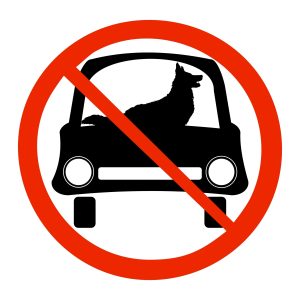
Safe and sound
Dogs are most secure in their own crate or carrier in the back of a car.
Use a safety belt harness for dogs who travel on the passenger seats.
Avoid travelling with dogs on your knee.
Don't let your dog travel in the front passenger seat or footwell. They might distract you or get between your foot and the control pedals.
Please don't let your dog put their head out of the window when you're driving. Unsurprisingly, dogs love feeling the breeze on their faces at speed. But it can lead to tragedy if they’re hit by a car coming the other way. And serious eye problems can result from a fly, stone or piece of grit getting into your dog's eye while you’re travelling at speed.
Never leave your dog in the car in warm or sunny weather. Dogs die in hot cars.
2. Plan ahead
Your dog's first car journey shouldn't be 8 hours on a motorway or a long winding road.
Get your dog used to travelling shorter distances and build up gradually.
In the summertime, travel later or earlier in the day. It’ll be cooler and the roads will be quieter.
Only feed your dog a light meal before travelling. And give it at least an hour or two before leaving. Take them for a walk before starting out.
Keep the car windows open or air conditioning on and ensure your dog's area is kept cool and well ventilated.
Calming products such as Adaptil collars, Thundershirts and food supplements like Zylkene can help relax nervous dogs.
Speak to a vet about medicine for travel sickness if your dog still won't settle in the car.
3. Schedule comfort breaks
It’s not just the human passengers who will need a break when travelling:
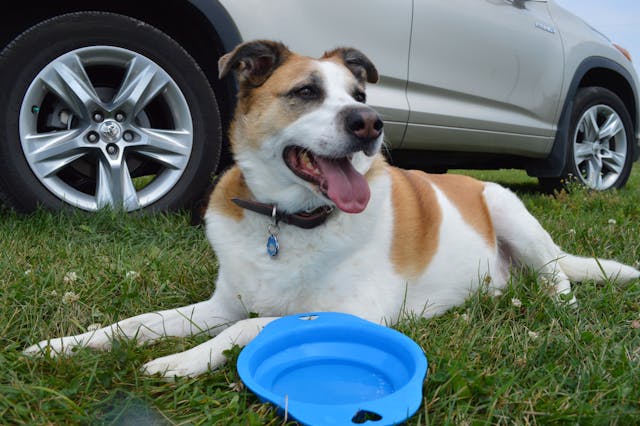
Check the route before you go so you know where to break up longer journeys with comfort breaks for everyone.
Carry plenty of fresh water for your dog and a bowl.
Don't forget the poo bags.
If it's a long journey, carry light, easy-to-digest food for snacks, unless your dog is travel-sick
Plan a picnic for the human passengers as well. Dogs die in hot cars, so you won't want to leave them while you go to a cafe for lunch. 54 dogs died from heat stroke in 2022. That was only the recorded number. The real figure may be even higher. You could also check out quiet pet-friendly cafes on the route, so you can all keep cool together.
Always keep your dog on a lead near busy roads.
4. Are we nearly there yet? Boredom busters
It’s not just human passengers who get bored on long journeys (or even short ones, come to that).
Boredom busters for dogs
If you can't persuade your dog to play 'I-spy' or '20 questions', take along a favourite toy or blanket.
Some dogs are happier when they can see the views out the window.
Use relaxing music to create a calm and soothing atmosphere.
Break up the journey with detours to a grassy park to play. Or at least a Motorway Service Station that has some grassy areas.
5. Expect the unexpected
Let’s face it, even with the best-laid plans, stuff happens. Be prepared and you won't be caught out.
If you're travelling far from home, consider carrying a pet first aid kit. Include antiseptic wipes, a tick remover, scissors, wound dressings and cooling pads.
Take a supply of towels, puppy pads and doggy wipes. Be prepared if there’s a chance your furry friend may be sick or have an accident in the car. (Maybe throw an air freshener in the bag as well!)
Check that your dog’s microchip contact details are up to date.
Travelling by train
Well-behaved dogs can travel on trains with their owner, as long as they stay on a lead or in a secure carrier.
You can take up to 2 pets with you free of charge, but any more and you need to contact the train company first.
Just like travelling by car, try to break up the journey and travel on quieter trains at quieter times of the day. Travelling on a packed train in the height of summer could be an uncomfortable experience for you and your pet.
Remember, your dog can't pee or poo on a train, so journeys can only be as long as they can comfortably wait between walks.
Travelling by bus
Many UK buses will allow travel with one small dog. However, It's always up to the driver. And usually, only one pet at most is allowed on any bus. If the bus is busy, the driver may say 'no'. If you are relying on the bus, plan for alternative times and routes as a back-up.
If you do travel by bus, keep your pet on a lead or in a carrier, and clear of the gangway. It could be cramped!
Travelling can be strange and unsettling for dogs. Loss of routine, strange smells and loud traffic noise are going to leave them feeling exhausted. They may become restless and agitated. Whether you travel by car, bus or train, give your dog time to get used to new surroundings. Be patient and keep your dog on a lead when you arrive.
Travelling across borders with dogs
Advance planning is essential for travelling to Northern Ireland or abroad with your dog. And there’s some major changes to Pet Travel regulations taking effect from the 22nd April 2026. Talk to your vet as soon as you start to think about taking your dog to another country.
Travel between Northern Ireland and Great Britain (England, Scotland, Wales)
To travel from Great Britain to Northern Ireland, your dog will need:
A microchip: By law, all UK dogs should be microchipped irrespective of travel plans.
A Northern Ireland Pet Travel Document (PTD): You can apply for a PTD online. It’s free and lasts for as long as you own your dog.
You can’t take more than 5 dogs to Northern Ireland unless you're attending an event (competitions, shows, sporting events) or training for one. You’ll need written proof of registrations for this.
For travel from Northern Ireland to Great Britain, NI resident dogs need:
A microchip
Northern Ireland pet owners do not need a Pet Travel Document to travel to and from the UK.
Travel to the European Union
As of April 2026, pet owners living in England, Scotland or Wales can no longer use their Pet Passports for travel in the EU, even if those passports were issued in the EU.
Instead you must apply for an Animal Health Certificate. To get this, your dog needs to see an Official Veterinarian (OV) no more than 10 days before you travel. Not all vets are OV's, so check with your local practice. You can add up to 5 pets to an Animal Health Certificate. NI residents may still use either EU-issued pet passports or an Animal Health Certificate for EU travel.
Travel requirements for travel from UK to the EU:
A microchip: Given before, or at the same time as their rabies vaccination.
Rabies vaccination: Given no earlier than 12 weeks of age.
A valid Animal Health Certificate.
Return to within 4 months of entry to EU.
Tapeworm treatment: 1-4 days before coming back to the UK or entering certain other EU countries, your dog needs an approved wormer from a vet. This needs to be recorded on their pet passport or health certificate.
Animal Health Certificates:
Require proof of:
Microchipping date
-
Up-to-date rabies vaccinations
If your dog needs a Rabies vaccination, they can only get an Animal Health Certificate once it’s taken full effect. Depending on Manufacturer’s guidelines, this will be at least 21 days after their first rabies vaccination or restarting lapsed rabies boosters.
How long do AHCs last?
Valid for entry to EU for up to 10 days from date of issue
Valid for onward travel in EU and return to the UK for 4 months after EU entry
Check the entry requirements for the country you're travelling to. Different countries can have different rules surrounding the frequency of rabies boosters and worming requirements.
If you’d like to learn more, you can find detailed guidance on the official UK Government website.
A word of caution!
There are some biting insects and other parasite disease hazards in EU countries that we don't have in the UK. Ask your vet about effective preventive care. It may not be required for a Pet Passport or Health Certificate but it could be life-saving for your pet.
However, you and your dog plan to spend the summer, have a wonderful time. And don't forget to take us with you!
Download the Joii app today for 24/7 access to pet care wherever you are in the world.


