


Cruciate ligament disease in cats

Overview
Symptoms
Risk
Diagnosis
Vet treatment
Home treatment
Prevention
When to worry

Cruciate ligament disease in cats
Cruciate ligament disease affects fewer cats than dogs (only 12.2% of cases affect cats). It usually results in back leg lameness. Not all cases require surgery for treatment.
The most common form of knee ligament injury is a torn cranial cruciate ligament (CrCL). In cats, it usually results from trauma. This disease can also be called CrCL rupture, CrCL tear, anterior cruciate ligament (ACL) disease, or a torn knee ligament.
What is cruciate ligament disease in cats?
Your cat’s knee is a complex structure consisting of multiple bones: thigh bone (femur), kneecap (patella), shinbone (tibia), ligaments, and meniscus (a cartilage ‘shock-absorber’ inside the knee joint).
The cranial cruciate ligament (CrCL) is one of four ligaments that hold the knee joint together.
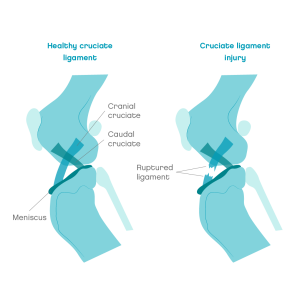
If the cruciate ligament is damaged, the knee becomes unstable and often very painful:
The cruciate ligament can tear partially or completely.
Cats are more likely to have other ligaments rupture alongside with cruciate damage.
Damage to the meniscus can occur in around 50% of cats that have cruciate rupture.
Limping is often the first sign to be identified.
Trauma is the most common cause, but inherited weak ligaments or obesity can cause cats to damage their cruciate ligaments too.
As a result of this condition, limb function will deteriorate if not treated, and arthritis will progress.
What are the signs of cruciate ligament disease in cats?
You might notice some or all of the following in your cat:
Limping, that can start suddenly, worsen, persist, or become occasional
A painful leg
Reluctance to exercise or play, or difficulty jumping and using the stairs
Stiffness
Change in behaviour: quieter than usual, hiding
People express pain and discomfort differently from pets, so although cats may not meow, cry out, or hold up their sore limb constantly, the persistence of their lameness is a sign of pain.
Cats will hide pain as much as possible. They’re much less likely to limp or cry than dogs are if a joint hurts, so visible and persistent limping is an important symptom of joint pain and one that needs prompt veterinary assessment.
Are some cats more at risk of cruciate ligament disease?
Cruciate ligament disease is mostly seen in:
Outdoor cats or very energetic/playful cats who suddenly jump or turn as they run. The ligaments are damaged by a twisting injury to the knee.
Old age can weaken the ligaments.
Obese cats can damage their ligaments due to the excess strain on the joints. Check your cat’s body score condition (BSC) to see if they are overweight.
Diagnosis of cruciate ligament disease in cats
Complete tears of the cruciate ligament
Diagnosed by your vet using a combination of:
Watching the way your cat walks
Hands-on examination (including a special knee movement test, which is usually done under sedation)
Radiographs (X-rays)
Occasionally MRI
Partial cruciate ligament tears
Can be more challenging to diagnose, requiring a visual inspection of the joint with:
Exploratory surgery (open knee surgery)
Arthroscopy (keyhole surgery with a camera on the joint)
This type of investigation may need to be conducted by a specialist vet in a referral hospital.
Vet treatment for cats with cruciate ligament disease
There are two treatment options for cruciate disease: medical management and surgery.
Depending on the level of severity, your vet will offer the best option for your cat.
Medical management
Non-surgical treatment is, for many cats, the best option. For best results, all of the following are recommended:
Activity restriction for several weeks
Anti-inflammatory and pain relief
Weight management or weight loss
Joint supplements to slow the progression of arthritis
Rehabilitation and physiotherapy
Surgery
Surgery is less likely in cats, but your vet may advise it if your cat’s knee is severely unstable, or they have pain that isn't going away or improving with rest and medication alone.
It’s also more likely if:
The joint is very loose
More than one ligament is injured/torn
There is damage to the meniscus
A bone is injured or broken
Surgery doesn’t repair the torn ligament directly. Instead, it aims to stabilise the knee using special supporting stitches or by changing the shape of the bone. The surgery may need to be performed by a specialist vet at a referral hospital. Surgical options include:
Extracapsular suture stabilisation: A strong stitch is placed outside the joint to support it; the most common surgery in cats.
Tibial Plateau Levelling Osteotomy (TPLO): The shin bone is cut and repositioned to improve stability; used in more severe cases.
Cranial Closing Wedge Ostectomy (CWO): A small wedge of bone is removed to change the bone angle. Less commonly performed.
Tibial Tuberosity Advancement (TTA): The front of the shin bone is moved forward to improve joint stability.
How to help your cat with cruciate ligament disease at home
Follow your vet's recommendation and exercise restriction plan.
Your vet's plan will be very detailed for the first 6-8 weeks.
Keep them calm using cage rest, leaving them in small rooms of the house with no access to high furniture.
Keep their minds busy by feeding them in slow feeders and play mats
Start physiotherapy as soon as possible and continue for the following 3 months. The protocol sessions will change as they reach different stages of treatment.
A healthy weight is necessary both for the injured knee, as well as, to prevent the other knee from getting injured.
Start them on a good joint supplement to slow the progression of arthritis.
Lots of cuddles, love, and patience.


Living with a cat with cruciate ligament disease
The progression of arthritis is likely: To slow the progression of the disease, we recommend starting your cat on a good joint supplement as well as doing some home modification to help your cat move easily. See our arthritis article for more information.
Use the following links to find qualified physiotherapists:
The Register of Animal Musculoskeletal Practitioners (RAMP), The Association of Chartered Physiotherapists in Animal Therapy (ACPAT), National Association of Veterinary Physiotherapists (NAVP)P
How to prevent your cat from developing cruciate ligament disease
It is difficult to prevent this condition. Maintaining a healthy weight is still important for obese cats, but this condition occurs mainly due to trauma while out and about or during playtime.
When you should be worried about your cat with cruciate ligament disease
If your cat was diagnosed with cruciate disease, contact your local vet practice if they are:
Not improving despite treatment
Painful, swelling, or stiff in any joint
Struggling to run, jump, or use the stairs
Joii can help:
If your cat had treatment for cruciate disease and you need tips to keep them calm and rested at home
If your cat is having vomiting, diarrhoea, or loss of appetite
If you need help slowing the progression of arthritis
Advice for weight management and feeding


