


Cruciate ligament disease in dogs

Overview
Symptoms
Risk
Diagnosis
Vet treatment
Home treatment
Living with a dog with cruciate ligament disease
Prevention
When to worry

Cruciate ligament disease in dogs
Cruciate ligament disease is a common orthopaedic problem that results in back leg lameness. It usually requires surgery for treatment. Dogs of large and giant breeds are more prone to this condition, but it can affect dogs of any breed or age.
The most common form of knee ligament injury is a torn cranial cruciate ligament (CrCL). It may result from trauma or be due to an inherited weakness. Within one year of undergoing surgery, 20-50% of cases develop a ligament tear in the opposite knee, so treatment should begin as soon as possible to prevent further injury. This disease can also be called CrCL rupture, CrCL tear, anterior cruciate ligament (ACL) disease, or torn knee ligaments.
What is cruciate ligament disease in dogs?
Your dog’s knee is a complex structure consisting of multiple bones: thigh bone (femur), kneecap (patella), shinbone (tibia), ligaments, and meniscus (a cartilage ‘shock-absorber’ inside the joint).
The cranial cruciate ligament (CrCL) is one of four ligaments that hold the knee joint together.
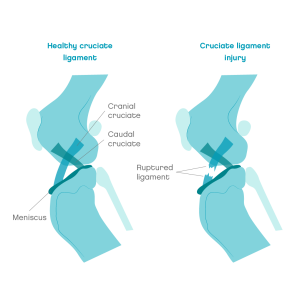
If one of the cruciate ligaments is damaged, the knee becomes unstable and often very painful:
The cruciate ligament can tear partially or completely.
Damage to the meniscus can occur in a large percentage of dogs with cruciate rupture.
Limping is often the first sign seen.
Causes of cruciate ligament injury include exercise, inherited weak ligaments, and obesity. Yet, any breed, size, or age of dog can injure their cruciate ligament.
As a result of this condition, limb function will deteriorate if not treated, and arthritis will progress.
What are the signs of cruciate ligament disease in dogs?
You might notice some or all of the following in your dog:
Limping that can start suddenly, worsen, persist, or become occasional
Painful leg
Reluctance to exercise or difficulty getting up, jumping, or using stairs
Swelling of the knee joint
Sitting with the affected limb extended out to the side
Loss of muscle mass in the affected leg
A dog may express pain differently from humans. They may not whine, cry or hold up the affected leg all of the time. But persistent lameness should always be treated as a possible symptom of pain and investigated by a veterinary surgeon.
Are some dogs more at risk of cruciate ligament disease?
Cruciate ligament disease is mostly seen in:
Athletic dogs who suddenly jump or turn as they run. The ligaments are damaged by a twisting injury to the knee.
Breeds that have weak ligaments, such as Newfoundland, Labrador Retriever, Rottweiler, Staffordshire Terrier, Mastiff, Akita, and Saint Bernard.
Larger dogs weighing more than 22 kg are at greater risk of cruciate disease and tend to develop cruciate rupture at younger ages.
Advancing age (from 7 to 10 years onwards) can weaken the ligaments, meaning they may tear more easily, particularly in dogs weighing more than 15 kg.
Obese dogs can damage their ligaments due to the excess strain on the joints.
How vets diagnose cruciate ligament disease in dogs
A complete tear of the cruciate
Is diagnosed by your vet using a combination of:
Watching the way your dog walks
Hands-on examination (including a special knee movement test, which is usually done under sedation)
Radiographs (X-rays)
Occasionally MRI
Partial cruciate tears
Can be more challenging to diagnose, requiring a visual inspection of the joint with:
Exploratory surgery (open knee surgery)
Arthroscopy (keyhole surgery with a camera on the joint)
This type of investigation may need to be conducted by a specialist vet in a referral hospital.
Vet treatment for dogs with cruciate ligament disease
Treatment consists of surgical and medical management. Even when surgery is recommended, medical management after surgery is essential.
Surgery
Surgery is usually the recommended treatment option to restore function to the affected knee.
Surgery doesn’t repair the torn ligament directly. Instead, it aims to stabilise the knee using special supporting stitches or by changing the shape of the bone. The surgery may need to be performed by a specialist vet at a referral hospital.
Depending on your dog's medical needs, the vet may recommend one of the following surgical techniques:
Extracapsular suture stabilisation: A strong stitch is placed outside the joint to support it.
Tibial Plateau Levelling Osteotomy (TPLO): The shin bone is cut and repositioned to improve stability.
Tibial Tuberosity Advancement (TTA): The front of the shin bone is moved forward to improve joint stability.
Medical management
Non-surgical treatment may be appropriate in small dogs, in cases of partial cruciate tears, or in cases where surgery is not an option due to financial limitations or anaesthetic risk.
For best results, all of the following will be needed:
Activity restriction for several weeks
Anti-inflammatory and pain relief medication
Weight control or weight loss
Joint supplements to slow the progression of arthritis
Rehabilitation and physiotherapy
A custom-made knee brace may also be recommended to stabilise the damaged knee, reduce pain, and allow some return of function. However, there isn't much research in veterinary medicine to support this option.
How to help your dog at home if they have cruciate ligament disease
Follow your vet's recommendation and exercise restriction plan.
Your vet's plan will be very detailed for the first 6-8 weeks.
Keep your dog rested by using a cage or leaving them in small rooms of the house with no access to high furniture (sofa or bed).
Keep their minds busy by feeding them in slow feeders and play mats.
Start physiotherapy as soon as possible and continue for the following 3-6 months. The protocol sessions will change as the bone heals and the main goal changes.
A healthy weight is necessary both for the injured knee, as well as, to prevent the other knee from getting injured.
Start them on a good joint supplement to slow the progression of arthritis.
Lots of cuddles, love, and patience.


Living with a dog with cruciate ligament disease
Is post-operative care difficult?
There are a few points that can cause frustration due to the length of the treatment time. These are the exercise restrictions and physiotherapy.
Activity is highly restricted for 6-8 weeks after surgery.
The activity restriction may be less if a TPLO or TTA has been performed.
Within 3 months, good function should return to the limb if you follow your vet’s instructions and keep up with the physiotherapy.
Many joint supplements are available; which one should you choose?
The key ingredient a joint supplement should contain is:
Green lipped mussel extract (a bivalve mollusc extract)
Omega-3&6 fatty acids (polyunsaturated fatty acids)
Other ingredients that may also have an effect are:
DPLA (a protein that is believed to have pain relief and mood elevating effects)
SAMe (a compound found naturally in the body)
CBD (an active ingredient in cannabis extracted from hemp plant)
Hyaluronic acid (a component of joint fluid that gives it elasticity)
Chondroitin sulphate (extracted from mammalian cartilage, normally cow windpipes)
Collagen hydrosylates (also known as gelatin; it’s made from collagenous structures of mammals such as bovine tendons)
Glucosamine (a natural compound found in cartilage)
Vitamin E
Are physiotherapy and rehabilitation important?
ACL tears typically require expensive surgery and physiotherapy to improve limb function and quality of life.
Physiotherapy supports successful recovery and prevention of injury to the other knee.
Physiotherapy can begin the day after surgery and should continue for 8-12 weeks.
You can use the following links to find qualified professionals:
Physiotherapy: The Register of Animal Musculoskeletal, Practitioners (RAMP), The Association of Chartered Physiotherapists in Animal Therapy (ACPAT), National Association of Veterinary Physiotherapists (NAVP)
Hydrotherapy: National Association of Registered Canine Hydrotherapists, Canine Hydrotherapy Association
The progression of arthritis
Unfortunately, all dogs who suffer ACL rupture will develop arthritis, which will worsen over time. To slow the progression of the disease, we recommend starting your dog on a good joint supplement as well as modifying their exercise regime over time.
See our arthritis article for more information.
How to prevent your dog from getting cruciate ligament disease?
It isn’t possible to completely remove the risks of cruciate disease in every dog. However, the following measures will help reduce the likelihood of ligament stress and tears.
Keep your dog at a lean, healthy bodyweight and condition score.
Exercise your dog regularly and appropriately to their age, size and breed: avoiding sudden extremes.
Be cautious playing with bouncy balls and frisbees: twisting jumps are more likely to result in injury.
When you should be worried about your dog with cruciate ligament disease?
If your dog was diagnosed with cruciate disease, contact your local vet practice if they are:
Not improving despite treatment
Painful or stiff or there is swelling in any joint
Struggling to run, jump, or use the stairs
Joii can help:
If your dog had treatment for cruciate disease and you need tips to keep them calm and rested at home
If your dog is vomiting, has diarrhoea, or a loss of appetite
If you need help and advice on slowing the progression of arthritis


